How to use colour preferences to build more effective team communication
Blog
Discover how understanding colour preferences can help your team thrive together and achieve even greater success.
In this article, we delve into the fascinating world of colour preference profiling and how it can directly impact how successful your teams are at communicating to understand one another and therefore their overall performance as a cohesive unit.
What are colour preferences?
We are all unique and have our preferred way of doing things (our behaviours), however, human behaviours can be complicated. To simplify things, our behaviours can be meaningfully associated with colours to help us understand ourselves and others.
Our four colour preferences and their colour combinations affect how we communicate with one another and directly impacts how successful our communication is within our teams.
To understand more about how behaviours can be categorised with psychometric profiling see our article: Why behavioural assessments are more effective in business than personality tests.
The key to remember here is we all possess all four colour preferences but in a personal combination. How we express our combination is unique to us. Understanding this can affect how well we are maximising our own strengths and raise our awareness of how we are impacting others.
Understanding the leading colours of those we work with will give us powerful insight in to how we might be able to work more effectively with them, instead of against them, due to misunderstanding.
The focus of this article is on how our awareness of colour preferences can powerfully affect team communication, so here is an example team:
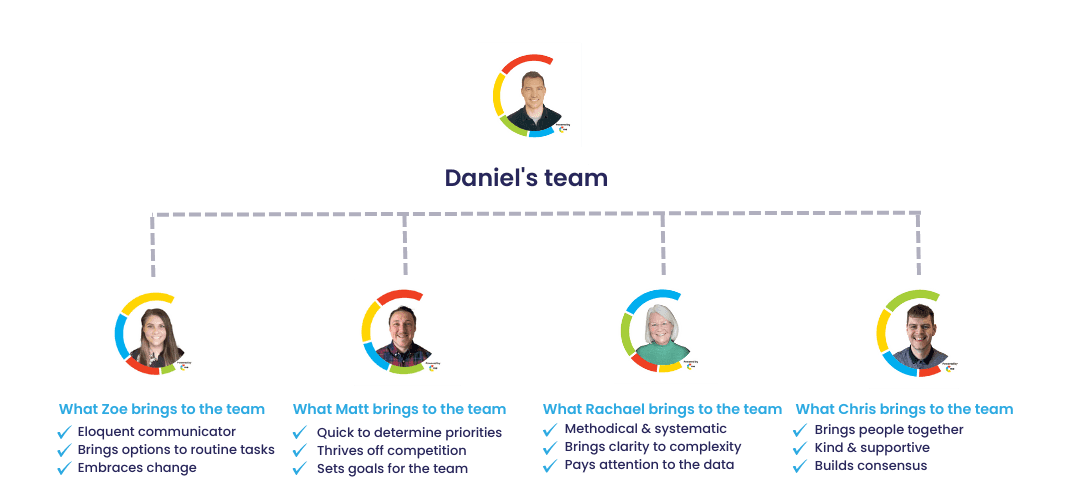
In this diagram above we have represented each person’s preferred colour combination in a 'C' icon around their profile picture to make it easy and quick to identify.
Each of Daniel’s team members bring a combination of communication strengthsto the table.
Self-awareness of what they each bring is step 1; step 2 is to understand what others bring to the team and then learn how to communicate with them, especially those who may be completely different in behavioural style and motivations.
As you can see, Zoe leads with a yellow/blue primary preference. At least one of her top two colour preferences are shared with her team members. This indicates she may find it easier to communicate with her team members than with someone outside of her team who may have the totally opposite colour combination.
The good news is that there are ways she can learn to understand others better and adapt her behaviour to perform better together.
Learn the effective and ineffective ways to communicate with one another according to colour preferences
Here is just one of the ways we do this at C-me, we call this the ‘Dos’ and ‘Don’ts’ of team communication.
This wheel is showing you what to do to communicate most effectively with your colleagues who lead with different colour preferences, or ‘effective’ communication strategies.
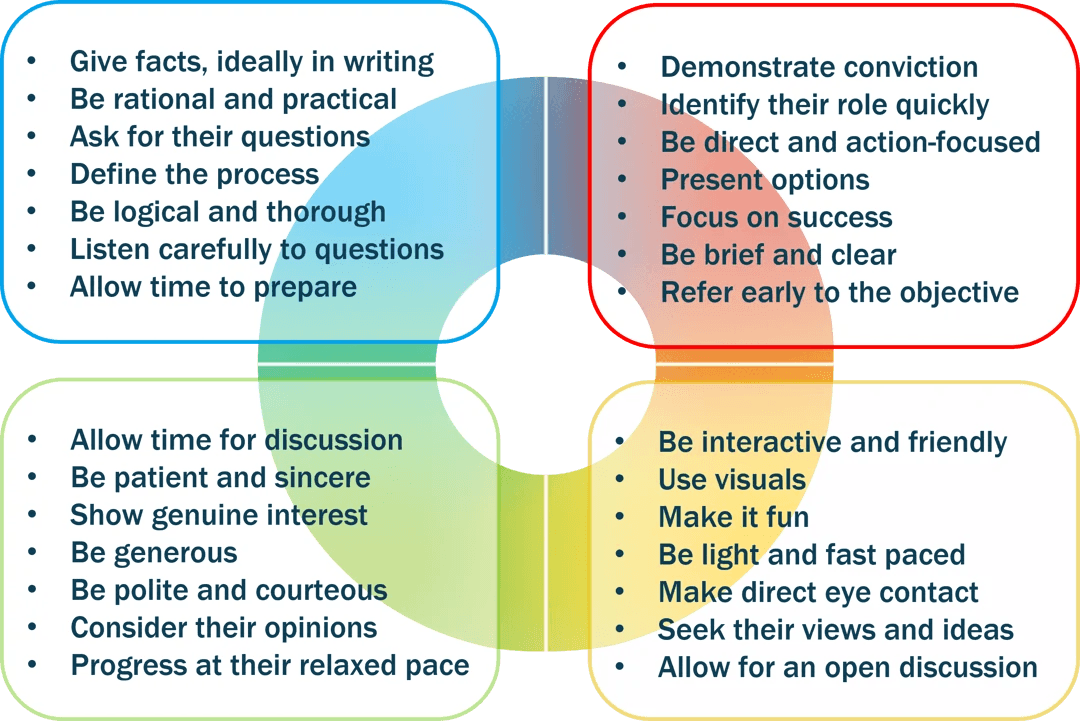
Alternatively, this wheel is showing you what to avoid doing, to communicate most effectively with your colleagues – we call this ‘ineffective’ communication behaviour.
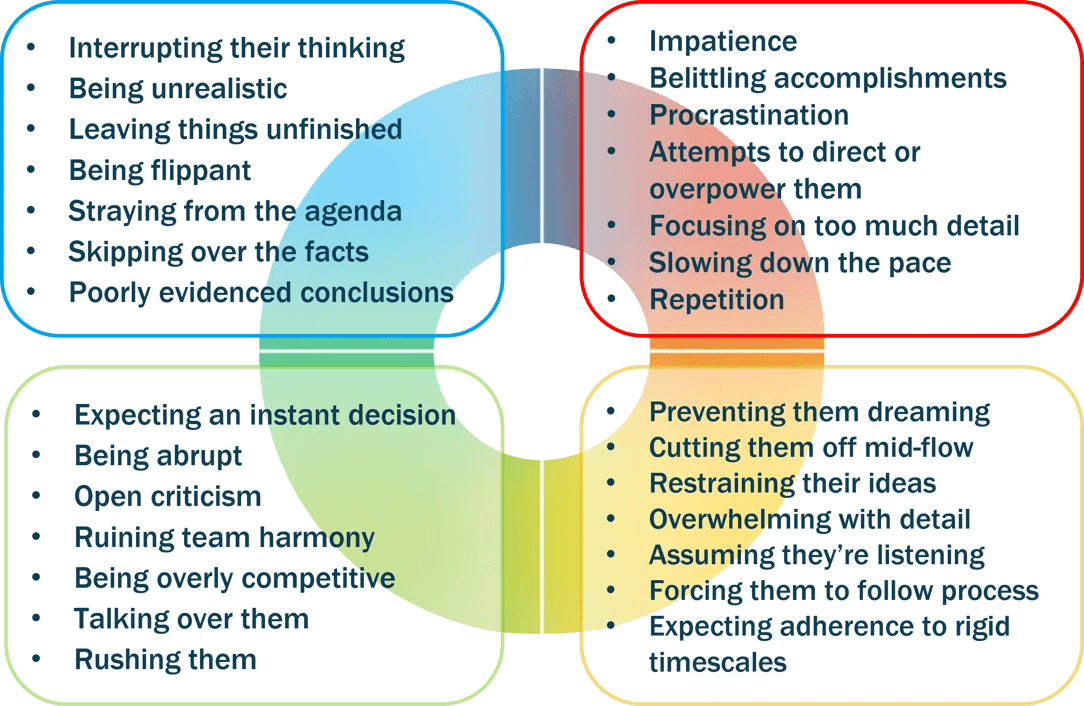
When you know your own colour preferences you can then focus on adapting your behaviour with simple actions like the above diagrams illustrate, they are simple but powerful, to improve your team collaboration and address miscommunication and misunderstandings.
Would you like a free C-me profile? Book a demo with one of our team.